
Battle Ground Voter Lookup
VoteWA is the first route for a Battle Ground voter checking an individual record. It authenticates the voter rather than letting a visitor browse names. Enter the same first and last name used for voter registration, the full date of birth, and the required challenge. A successful sign-in can show active or inactive status, ballot availability and tracking, election choices, districts, personalized drop boxes and vote centers, and voter-guide material.
| VoteWA field | Input | Required | Match rule |
|---|---|---|---|
| First Name | Text | Yes | Must match the registration name |
| Last Name | Text | Yes | Must match the registration name |
| Date of Birth | Date or text | Yes | Exact MM/DD/YYYY format |
| reCAPTCHA | Challenge | Yes | Blocks automated access |
If the entries do not match, VoteWA points the person toward registration or elections help. Multiple matches may prompt address selection. The Clark County Elections office remains the local fallback for a registration problem, ballot issue, address update, or unclear Battle Ground precinct. Staff can interpret local district codes, but the personal portal is not an anonymous public directory.
The official VoteWA sign-in screen shows the exact-name and birth-date prompts used for voter registration access.
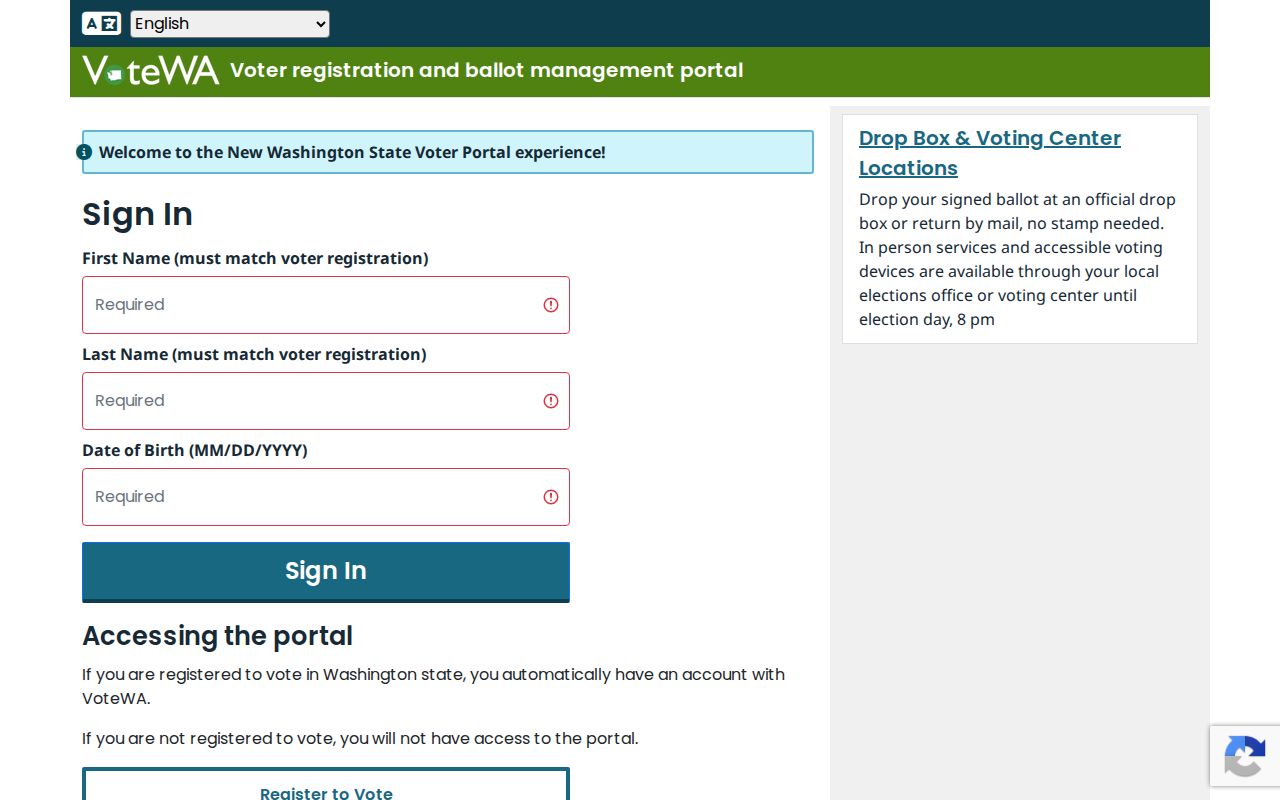
The form’s narrow set of fields reflects its purpose: confirming one voter’s identity before revealing personalized election details.
Note: Use the registered name, not a nickname, before treating a failed Battle Ground voter lookup as evidence of no record.
Battle Ground Voter Record Fields
Washington law defines a precise public slice of each voter record. Under RCW 29A.08.710, the available fields are name, address, political jurisdiction, gender, birth year, voting record, registration date, and voter number. A voting record means participation in an election. It does not reveal a ballot choice. Washington also does not register voters by party, so the voter rolls contain no party-preference field.
| Identity | Name, gender, birth year, and state voter number |
|---|---|
| Address | Structured residence and mailing fields, except protected records |
| Districts | County, precinct, precinct part, legislative district, and congressional district |
| Registration | Registration date and current status code |
| Participation | Last-voted date and election participation, never ballot selections |
These fields can help distinguish people with similar names or isolate Battle Ground records from the larger Clark County file. Yet an extract is only a dated snapshot. Preserve its update date, status code, registration date, and last-voted field when comparing two versions. A later change may reflect routine address maintenance rather than a conflict in identity.
Washington Voter Registration Privacy
The public fields do not make the full registration form public. Original forms and signatures stay closed, as do identification data, full birth dates, phone numbers, email addresses, and the agency where a person registered. The choice not to register during a state-agency transaction is also confidential. Future-voter information for an underage registrant receives added protection.
| Name | Public unless excluded through protected-voter rules |
|---|---|
| Residence Address | Public in structured form, except for protected participants |
| Party Affiliation | Not collected because Washington has no party registration |
| Voting History | Shows participation, never how a ballot was marked |
| Date of Birth | Birth year is public; full date is confidential |
| Status | Active, provisionally active, pending, inactive, or cancelled |
Confidential by Washington law. RCW 29A.08.710 and .720 withhold all registration information beyond the named public fields. RCW 40.24.060 also excludes Address Confidentiality Program participants from public voter lists.
A requester should not try to infer or rebuild hidden fields by combining the voter file with other sources. The legal boundary follows the field itself, not just the form or database where it first appeared. That is especially important for an actual residence shielded by the state’s protected-voter process.
Battle Ground’s 33-Field Extract
The statewide voter registration database extract carries 33 columns. Name components occupy separate fields, as do structured street parts, unit data, city, state, and ZIP. County and precinct codes sit beside legislative and congressional districts. Mailing-address columns may differ from the registration address. The last group records registration date, last-voted date, and status code.
For Battle Ground research, select the Clark County file and then use county district-code or precinct mapping to isolate the city. The state output is not prefiltered to Battle Ground. This matters because a postal city name is not itself a voting-jurisdiction boundary, and countywide data can include addresses that readers may casually associate with the city.
- StateVoterID
- The state’s voter number, useful for tracking one record across dated files.
- PrecinctCode and PrecinctPart
- Local election geography used with Clark County mapping.
- Registrationdate
- The registration date stored in the extract.
- LastVoted
- The last participation date, not a ballot choice.
- StatusCode
- The current registration-maintenance classification.
Note: A Clark County selection narrows the file, but district and precinct mapping is still needed to identify Battle Ground voter records.
Battle Ground Voter Roll Status
Status codes need careful reading. Active means fully qualified. Provisionally active means the voter has a ballot but must provide identification before it can count. Pending signals an unresolved or still-processing record. Inactive commonly follows undeliverable mail or a move. It does not mean that someone merely skipped an election, nor does it by itself prove ineligibility.
An inactive voter can reactivate by updating an address, requesting a ballot, registering again, replying to confirmation, or voting or attempting to vote. Under RCW 29A.08.630, cancellation may follow two consecutive federal general elections in inactive status without action. Other causes include the voter’s request, a duplicate, death, disqualification, qualifying felony custody, or a verified interstate move. State matching against death and custody data includes notice and a way to dispute the match.
Protected Battle Ground Voters
Participants in Washington’s Address Confidentiality Program use a special voter process. They provide an actual residence for district assignment, while their name, address, county, and precinct stay out of the public roll and ordinary VoteWA. The substitute-address and mail-forwarding program serves eligible people whose safety could be put at risk by public address disclosure.
A protected voter should not use the ordinary portal. County or state election staff can route the person to the Protected Records Voter process. For everyone else, an apparent absence from a public extract is not a sound basis for trying to reconstruct an address. The exclusion is an intended safeguard, not a data error.
Battle Ground Voter Requests Changed
Responsibility for standard voter data shifted on June 11, 2026. Under RCW 29A.08.105(3), the Secretary of State now fulfills statewide-database records and standard reports. Clark County’s current notice says the county no longer supplies voter lists, daily ballot-return reports, challenge reports, or similar VoteWA data. It routes those requests to the state within the response period.
The change did not remove Clark County Elections from local voter service. Its office at 1408 Franklin Street in Vancouver handles registration issues, ballot questions, updates, and local precinct or district interpretation. It is open Monday through Friday from 8:00 a.m. to 4:00 p.m., with possible expanded election-day hours. Phone service is available at 564-397-2345, and mail can go to PO Box 8815, Vancouver, WA 98666.
The Clark County Elections service page shows the local routes available to Battle Ground voters.
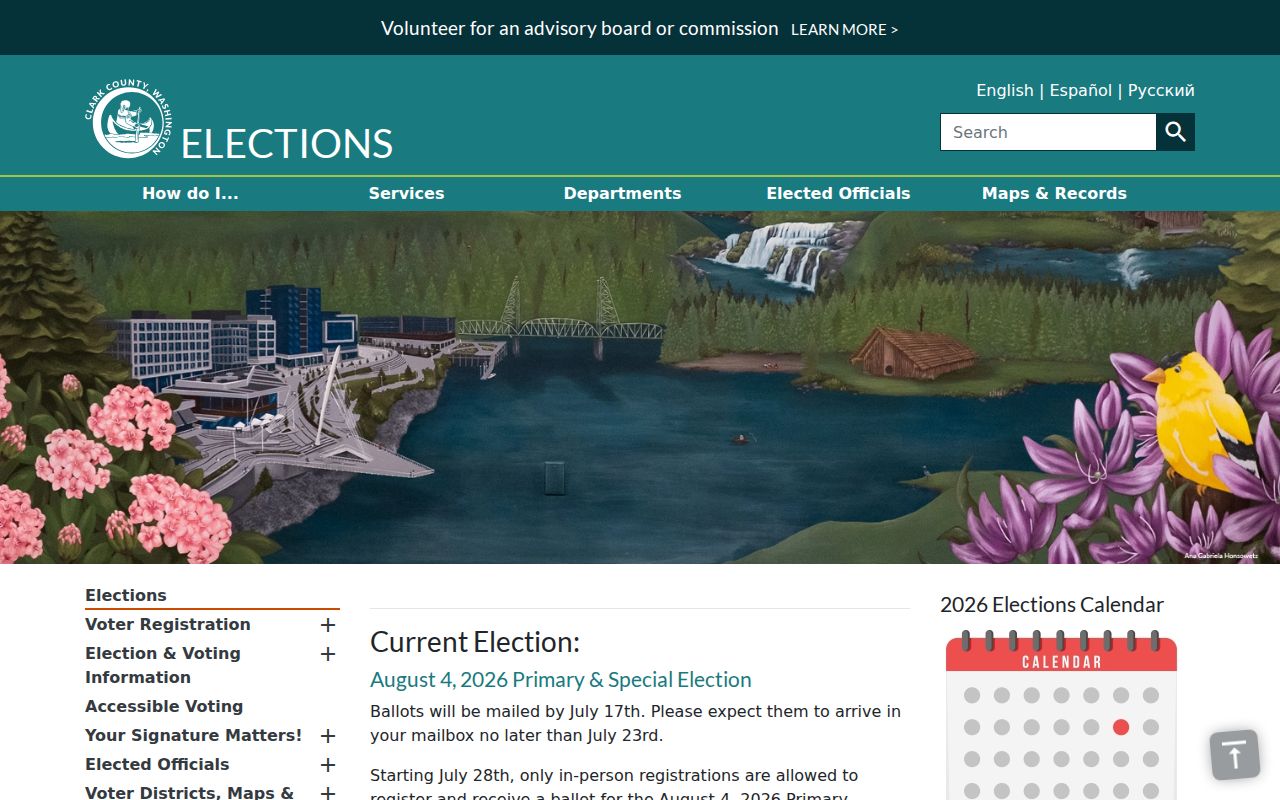
County help and state file fulfillment now form two distinct channels, so choosing the office by task avoids a needless handoff.
Note: Older Clark forms may still circulate, but the live June 2026 voter-data notice controls standard extract routing.
Requesting Washington’s Voter File
Any person may use the Washington voter database extract request; it is not limited to parties or campaigns. The requester supplies contact details, chooses a county file, and agrees to the governing use laws. Washington delivers a delimited CSV by an emailed download link. The state says delivery is usually immediate but allows five business days. A monthly update is usually posted by the end of the first business day.
- Enter the required first and last name, email, phone, street address, city, state, and ZIP.
- Select Clark County for the relevant voter file, and leave the form’s honeypot field blank.
- Affirm compliance with RCW 29A.08.720, RCW 29A.08.740, and RCW 42.56.070(8), then submit.
- Use the emailed link to download the CSV, and preserve its update date before filtering precinct or district codes.
No fixed fee or payment field is stated on the form, though RCW 29A.08.720 permits actual reproduction cost. For a nonstandard existing election record, contact the Secretary of State public-records office. The general access-law context for other local files belongs with Battle Ground public records procedures.
Use is tightly limited. RCW 29A.08.720 bars voter lists from advertisements, offers, and solicitation of money, services, or value. RCW 29A.08.740 makes prohibited use a class C felony, permits civil claims valued at $5 per item, and imposes a duty to take reasonable precautions.
Voter data must never be used to harass, stalk, threaten, or expose a protected person. Washington law separately addresses harassment, stalking, cyber harassment, and harmful publication of identifying information. Lawful access does not erase those limits.
Historical Battle Ground Election Records
Current voter-roll access is only one part of the record trail. The Washington State Archives preserves transferred election returns and pamphlets, and its Southwest Regional Archives lists Battle Ground municipal, school-district, and Clark County record groups. VoteWA status-change records may have retention schedules that allow destruction after capture, while some uncaptured notices are kept for three years.
No verified online year range was found for Clark County poll books or old registration registers. The sound fallback chain is the State Archives catalog, the Southwest Regional Archives, Clark County Elections, and library or newspaper collections for old election notices. Ask staff to confirm a series before relying on a zero digital result.
A nearby example shows why the archive route matters. The Clark County marriage collection provides a long-running, name-searchable historical series even though it is not a voter roll.
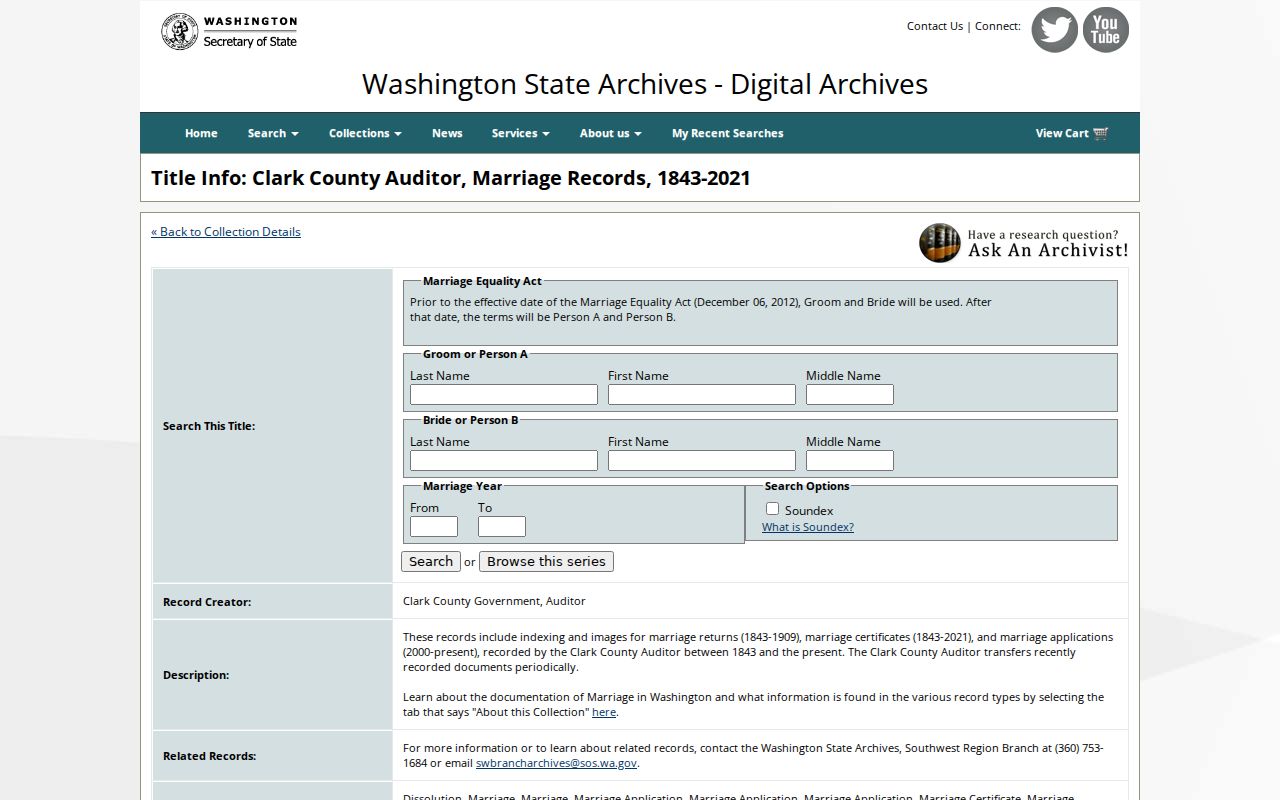
Its searchable structure illustrates how transferred county records can survive outside a modern agency portal and support historical identity work.